Introduction
This is the second article of four articles in my series. The previous article covers the timeline associated with internships and graduate programs. So, how do you maximise your odds of landing a role? The obvious answer is to be the best candidate possible, but how would you do that?
There are broadly four significant areas of development for a candidate, whether it’s contributing to what you can talk about or something you list on a resume. Ordered by relative importance, they are:
- Experience
- Volunteering
- Projects
- Academics
We’ll explore each area, but it’s worth noting that you don’t need stuff in each area and that two to three areas suffice. This concept is borrowed (somewhat shamelessly) from Nick Lambourne’s Getting that Grad/Intern Role article. Still, it really captures the broadest distinct criteria that you can undertake to improve your worth as a candidate. It’s also worth noting that some companies (anecdotally) favour one area over another (e.g. having prior work experience). Still, the specifics elude most people, and I’d focus on maximising your worth as a candidate across the board.
My Personal Path
One thing I’d also drive home is that everyone’s path through university is unique and that you can end up at the same place by following different paths. In my case, I tutored VCE mathematics in my first year while working on a few personal projects that I was interested in. In my second year, I joined MAC as an events officer. I worked to develop SETool, a web application for comparing university scores. At the end of my second year, I did summer research in deep learning. In my third year, I participated in UniHACK and was the events director of MAC. I did winter research in game theory before becoming the president of MAC and finally interning at Canva as an MLE. Some people I know have chosen to underload work, focusing on gaining professional experience or doing IBL, then getting into the more prominent companies after IBL.
Experience
Being able to list prior relevant work is a huge plus, but it’s only the end of the world if you have that. Most internships don’t require you to have 20 years of experience, as an internship is meant to introduce you to the workplace in a meaningful manner. That being said, some places are very competitive, and because they have a large pool of highly qualified candidates to select from, they may only filter interns with experience.
Tutoring and Research Assistant Roles
While in university, the opportunity to tutor may arise as a TA for a subject you’ve taken before, which usually results from doing well in the unit. TA’ing can be time-consuming, as you may be required to mark assignments. Still, it allows you to hone your teaching skills and discuss how you approach teaching in an interview.
As for research assistant roles, Monash offers winter and summer research programs, where you work with a professor on a project that usually contributes to some form of research. If you have an interest in academia, I’d especially encourage applying. Even if you don’t have a research interest, the work you do can vary wildly and can give you an idea of what you’d like to work on in the future. For Monash, you’re allowed up to three preferences and 500 words on why you’d be a good choice for any of your projects, which is a bit stupid, considering the tasks you chose could be different. There is some element of luck to these positions, as many people may apply for one project. Still, the choice inevitably comes down to the most convincing written application if the researcher has yet to plan to interview all candidates.
The research projects vary in pay and hours, but they tend to not be full-time work (usually). You’ll communicate with a researcher frequently to give status updates and see how the project’s direction is progressing. There’s no harm in applying, and you shouldn’t feel bad if you don’t get a position, as there are many other opportunities to apply for the research programs. It’s also worth noting that sometimes, researchers may reach out to you since they’re interested in what you’ve written to offer your project, which happened in the case of a friend and me. An academic reference is also handy if you wish to apply for postgraduate programs or need a reference for a job application.
IBL
As Monash offers the IBL program to anyone studying IT/CS/SE in Eng, you can receive a 6-month placement with a payment of about $20,000 (below minimum wage, in case you want to run the numbers, but it’s technically a scholarship). From memory, the IBL is undertaken in your third year at university, with the placement beginning in January. For this reason, there may be a clash between a summer internship and the IBL program if you do a three-year course. The IBL program is best explained by attending the IBL seminars. Still, you interview companies who score you based on how much they like you. Finally, you are either given a placement or are removed from the program. These internships can vary wildly, with some of my friends tasked to make slides for a couple of months to actual projects impacting the organisation they’ve been assigned to. I don’t have a strong consensus on this program, primarily because it can get in the way of a summer internship, which may be more worthwhile (especially if you’re interested in the more prominent companies) but is also a safer option for securing an internship, while not having to do the project unit you’d typically do. Whatever you choose should be your risk tolerance and the factors above.
Other Internships
Some other places may offer part-time work or internships; for instance, NAB offers a 6 to 12-month technology internship where you work 4 to 5 days a week at NAB. A common pathway I’ve seen about a program like this is that you can underload during a chosen year to intern at NAB, which gives you exposure to technology while reaping various benefits such as certifications and connections. At this point, you’ll be more prepared for summer internship applications at more reputable companies. If you’re not in a hurry to finish university and want to focus on the experience section, consider finding opportunities for part-time work, as many smaller companies care less about you being a student.
Volunteering
As I mentioned in the first article, club and student team involvement is seen as an effective method of gaining connections to break into the industry or gain leadership skills that you can discuss in interviews.
Club/Society/Team Involvement
These are some of the IT clubs and student teams at Monash:
- Monash Association of Coding (MAC): We run technical events on upskilling yourself and getting into the industry, for instance, topics in Machine Learning, building an application, or learning about frameworks.
- MONSEC: A cybersecurity club that runs workshops on the cybersecurity field, such as penetration testing, reverse engineering, cryptography, OSINT, and so on. They run weekly workshops and participate in CTFs (Capture The Flag)
- WIRED (FITS): The faculty’s official society, which is concerned with social events, technical events, and various other broadly IT-related activities.
- Commerce and Computing Association (CCA): A club that blends commerce and computing (with the intersection usually being tech consulting). They run more social/networking-related events.
- Monash Deep Neuron (MDN): An engineering student team focusing on deep learning and high-powered computing. Student teams are more involved, as you’ll be trained in deep learning or high-power computing and work on a project during your time there.
- Monash Algorithms and Problem Solving (MAPS): A student team focused on competitive programming, with weekly workshops on various competitive programming topics. I’d recommend this if you are interested in the more competitive companies.
- Monash Data Science Society (MDSS): A student club that is under the Monash Graduate Association (MGA), which is focused on data science.
So where should you go? The student teams generally have more commitment, as you’ll be expected to contribute towards long-running projects in addition to training and workshops, but also help contribute towards projects you may list on your resume. MDN looks for people in ML/DL or high-performance computing (HPC), so if your interests lie there, I’d put in an application when they’re recruiting. The other IT student teams, excluding MAPS, are less known to me and are newer, so you can learn more about them here. Suppose you’re interested in competitive programming or problem-solving. In that case, I highly encourage you to join MAPS, which now includes running regular workshops on problem-solving.
As for student societies, there needs to be more commitment, as each club endeavours to achieve the purposes enshrined in their respective constitutions. CCA and WIRED lean towards being social clubs; however, they still feature sponsored workshops that are technical on occasion, whereas MONSEC and MAC are focused on technical skills primarily. If you’re interested in cybersecurity, I highly recommend MONSEC, and if you’re interested in helping the community by delivering technical workshops, then look at MAC.
Networking
Quite a few students use referrals to increase their chances of getting a role, but what does a referral do? But, if you’re working at a company and know someone who would be an excellent fit for the role, you can refer them, which gives a signal to the recruiter that is, at the very least, better than applying without a reference. Should your friend get the role, you would receive a bonus for the successful referral.
The signal I mentioned can vary from company to company; some companies skip a stage of the process, and sometimes, it guarantees your resume will be seen, or it may have no effect (but they won’t tell you that). Nonetheless, if you have a few companies that you’re really adamant about getting into, you can find potential referees by:
- Cold calling people on LinkedIn, though I recommend sending an invite that conveys interest and intrigue. This approach also varies on the company, as some referrals are more personal, and they may feel uncomfortable handing out a referral to someone they don’t know.
- Talking to society members; they tend to have done internships at places you may be interested or may know people who have
- Hanging out on a Discord server - you tend to find a lot of people lurking around
With Canva, I chose to apply without any references. I got the role, so it’s by no means a necessity, but it can help your nerves if you need more clarification on your resume. The referee also gets a bonus if you get in (the amount varies wildly), so it’s worth remembering that employees have an incentive for referring you. The other benefit to networking is that you’re able to discover what the company does or anything noteworthy that you can later use in an interview to impress your interviewers or give them a signal that you’ve done your research on this company.
Projects
In place of prior experience, many students opt for the tried and tested approach of developing projects on the side because it shows that you can take the initiative and is a way of contextualising potential skills you’ve acquired. I often get the question of where you find a project, which is hard to answer. I can think of a couple of sources:
- Hackathons: See below.
- Subject Projects: You may work in a team to develop something that can be published and refined after you complete it
- Personal interest: Finding a problem you want to solve or something you want to do is often the best sort of project you can do
- Research Assistant work: This is basically an internship, but with the university, and may/may not be open source
Hackathons
Hackathons are competitions where you and a team build and pitch a product, typically over a short time frame, such as 48 hours.
Some of the hackathons that run include:
- UniHack
- HackAustralia
- MedHack
- Hackiethon
You can find a list of hackathons at hackathonsaustralia. A lot of the time, the winning prizes of these hackathons are web applications, which can be challenging, if not impossible, to do as a first-year if you need to become more familiar with web development. What’s my advice for hackathons? There’s a lot I’d love to talk about. Still, relegating this to a workshop or another article, as there are many strategies and launch pads that you could employ.
The most important thing I’ve gained from hackathons is the experience of working with your teammates. There will be many situations where you may disagree with some implementations or have differing views. That way, you’ll have many stories to discuss in behavioural interviews or mould around to answer behavioural questions. Additionally, being able to talk about specific details such as implementation and what you could have added provides fascinating talking points.
Personal Projects
My main point here is that you should only force yourself to do a personal project if you are interested in what you’re doing. If you do have something in mind you want to build, don’t shy away from it. Some common starting grounds for projects include making your own website if you’re a front-end developer, building a discord bot, a full-stack data science dashboard, or a web application for a problem you’re interested in building. I’d recommend using a large language model such as ChatGPT to learn how to tackle a project, including understanding the relevant technologies, what steps you’d need to take, and making a timeline for development.
Another reason I suggest embarking on a personal project is because you learn faster by writing code and grappling with how different libraries work.
My quick and fast tips for personal projects would be:
- Do it on something you’re interested in; that way, it feels more natural, and you’re not forcing yourself to work on it
- Start simple and build on features incrementally to avoid scope creep
- Document what you do, and make the repository easy to read
Leetcode / Competitive Programming
A significant aspect of the tech industry is the culture around the technical interview, popularised by Google and adopted by everyone in town. While many Reddit posts exaggerate the number of LeetCode problems solved without a FAANG offer, grinding out competitive programming problems and LeetCode helps mainly with the online assessment (OA). There is a degree to which it will help in the technical interview; however, the technical interview is more of a demonstration of your communication skills (sometimes called coachability), ability to test code, and problem-solve, not just how quickly you solve the problem.
Despite saying that, I still recommend doing either the Blind 75 as supplementary material to your data structures and algorithms course or alternatively gradually working on the NeetCode 150 roadmap. I recommend these problem sets because you will become more familiar with approaching problems in an OA. In addition, you should engage in mock technical interviews where you explain how to solve the problem and implement it.
Now, you want to truly go the distance and be competitive when solving these problems. In that case, I recommend diving into the world of competitive programming. A modest introduction to competitive programming would be through your local competitive programming club, which in the case of Monash would be the Monash Algorithms and Problems Solving Club (MAPS), by attending their workshops and attempting problems posed by them. Try your hand at the weekly Leetcode contests or Codeforces if you feel like destroying your sleep cycle. When learning problem-solving techniques, the goal is to progress with challenging problems and consolidate your understanding when you need a new approach to solving a problem.
Academics
The importance of your grade is widely contested, and it doesn’t matter past the screening stage in exceptional circumstances, as some places use your weighted average mark (WAM) as a cheap filter.
I’ve heard of companies that may look through your academic transcript and question your grades. My advice is to do your best, but feel encouraged to apply if your grades are different. If your WAM is notable, and you’ve got a commendation such as the Dean’s honour list, put that down on your resume. Some companies may also select you (at the resume stage) based on a high WAM, but these are, again, a few finance firms rather than the majority.
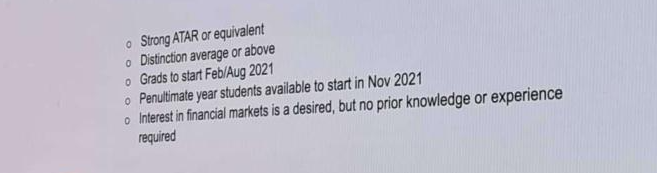
I’m still trying to figure out what counts as a strong ATAR, but oh well…
Conclusion - Part 2

Whenever you feel like holding back from an opportunity because you don’t feel you can do it, remember some say self-doubt is an invitation to be greater, this is your opportunity to prove it. Originally, I was to add a section on resume writing; however, it deserved its own section and will feature in the next article, Part 2.5 Final Mix, Curating your resume. I want to emphasise that there is no one golden path that sits above the rest, as everyone has different interests, and that you should try everything before settling into something that works for you.