Musings on Sparse Tables and Associativity
While learning about sparse tables, I found something quite insightful; the ideas behind binary lifting, where we we compute jump pointers to the nth ancestor, we break it up as the n/2th ancestor of the n/2th ancestor for a node. i.e ancestor(node, n) = ancestor(ancestor(node, n/2), n/2). We can go further but more importantly, why does this structure look familiar?
If we think back to binary exponentiation, we can write assuming is even, and then in general:
python
Or in ocaml:
ocaml
Notice that we quickly turn the problem into a logarithmic problem. This is actually a feature of associativity, believe it or not! In general, for a semigroup and binary operation , when we write , associativity gives us that . This is a signal that the order in which you evaluate doesn’t matter, so be aggressive and split the domain in half!
The Sparse Table
That brings us to the humble Sparse Table. For problems where we are given an array , queries and a binary operator , where we can say that and forms a semigroup, we can speed up the computation of time here. I will use as a form of notation here to basically mean applying our binary operator across the range.
Naively, you can just run that for each query, which would mean queries that could be steps, which means the time complexity here is , on the assumption that is a constant time operation. Not amazing. We ask ourselves, what can easily be computed? And can we reuse these building blocks?
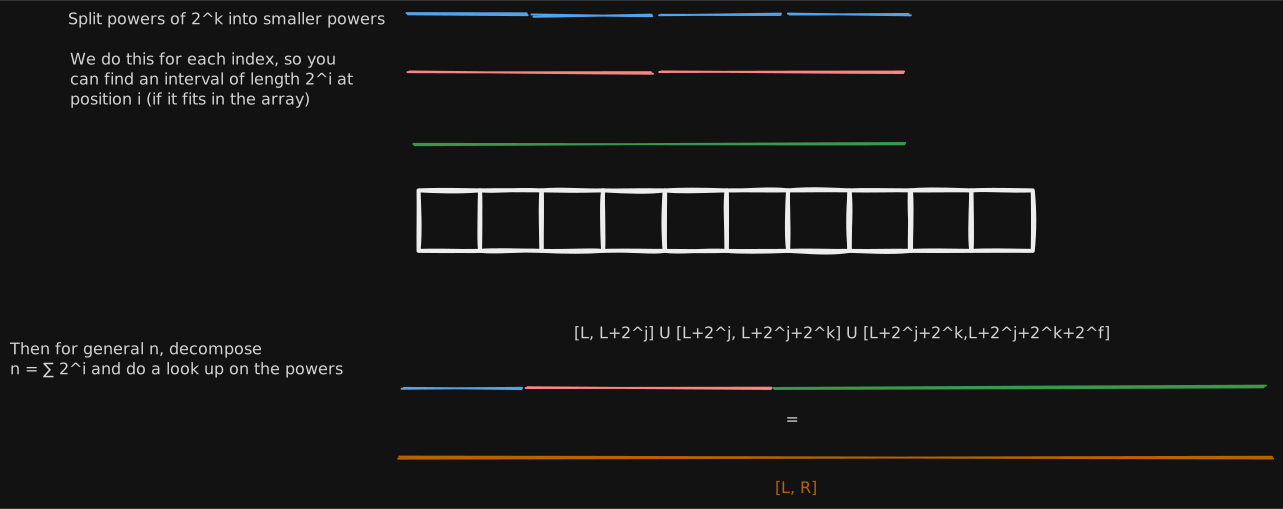 Yes you can. With powers of 2, we can break them up into smaller and smaller intervals. The diagram above tells us we have a natural relation:
In english, this means we can compute the property of a length interval by splitting it up into two evenly split sized intervals. And in code:
python
In steps, which is great, but not quite there for some that isn’t a power of . We know that , that is we can read off it’s binary representation to form a set of disjoint intervals that are powers of to get our result, which is . Recall that (1 << i) & n tells you whether the ith bit of n is on, so then we simply iterate over:
python
And thus, we have a really cool way of remembering how sparse tables work. To summarise:
- Compute intervals in powers of 2 in logarithmic time thanks to associativity
- Compute general interval lengths because of the binary representation
Also, it turns out, binary lifting is really just a sparse table implementation, but on trees. The binary operation in this case, is function composition, e.g , because you’re doing ‘jumps’. Neat!
Idempotency
Idempotency is the idea that for some operation we have that , i.e there is no change to the operation if applied repeatedly. In real world systems, such as payment systems, idempotency is a good property to ensure you don’t get double charged. It’s because of idempotency, that we can go from look-up to constant time look-up. In this case, we don’t really mind if there’s overlap in our intervals, so just pick the two intervals that tightly cover our desired query range . More concretely, I claim that its given by this formula.
Which operations are idempotent though?
- minimum, maximum
- GCD, LCM
There are probably more, but note that these operations all form a semigroup. If our function doesn’t change under repeated application, this means we can reduce the time for a query to constant time, by picking , then computing . We illustrate this with a diagram.
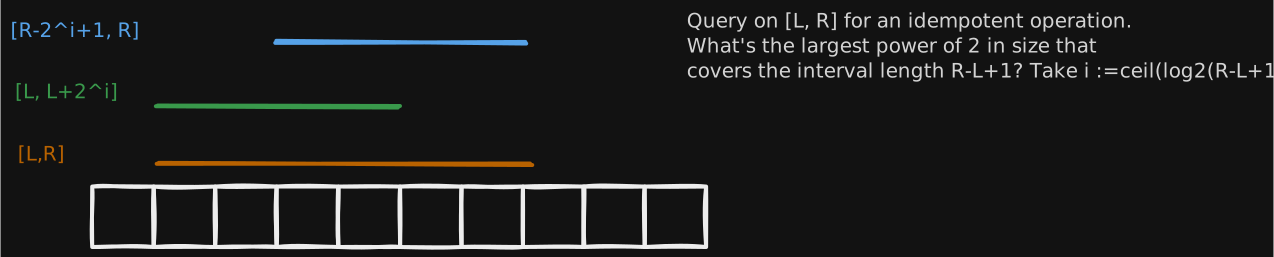
Bringing us to query time, and total time complexity.
Prefix Sums
It turns out when your operation has more structure, e.g an inverse (so you have a group structure), you can actually use an easier technique, prefix+suffix sums. Implicitly, you need the idea of being able to cancel/invert an operation. For range sum queries, it suffices to instead compute the prefix and suffix sums, so that when you want , you can simply look at sum(l,r) = prefix[R]-suffix[L-1].
Problems
There are less problems on Leetcode that cover this format, so we head to the more competitively aligned programming sites. In general, I find CodeChef questions extremely confusing to read, and preferred the problems from CSES.
Reflections
Python sucks for type checking, as it really lets you do stupid things that won’t raise an error, e.g indexing with a float (when raising to an exponent) won’t be immediately caught. Aside from this, once I had the intuition of associativity, I was mostly able to code up the implementation of a sparse table then recall that you can use (1 << i) & n to see if the ith bit was set. I did run into some intuition issues where I was computing the wrong ranges, but a good diagram really helps here. Additionally, other sites TLE even though my solution is within complexity :( - it’s easy enough to rewrite it in C++ fortunately as we don’t rely on any magical Python data structures.
Also, did you know Excalidraw has libraries that you can import from? For instance I can import a System design library for icons that I would have otherwise crudely drawn, or for DSA!
I found a relevant Codeforces article that outlines the insight that I found as well, while also generalising the idea to any monoid. I did mention that you can do this with a semigroup, but a monoid with identity makes this a bit nicer because you don’t need to deal with the weird empty edge case, and/or default initialise your values.
What’s next?
I want to learn about Fenwick trees and Segment trees, as they go further, and allow you to work with modifications to your data structure. I suspect that some properties of a monoid may help here. I found that the easiest way to think about learning how a sparse table works is through understanding the underlying algebraic requirements for it to work. It feels like a motivator for why category theory matters here, and why we even compute a sparse table to start within.